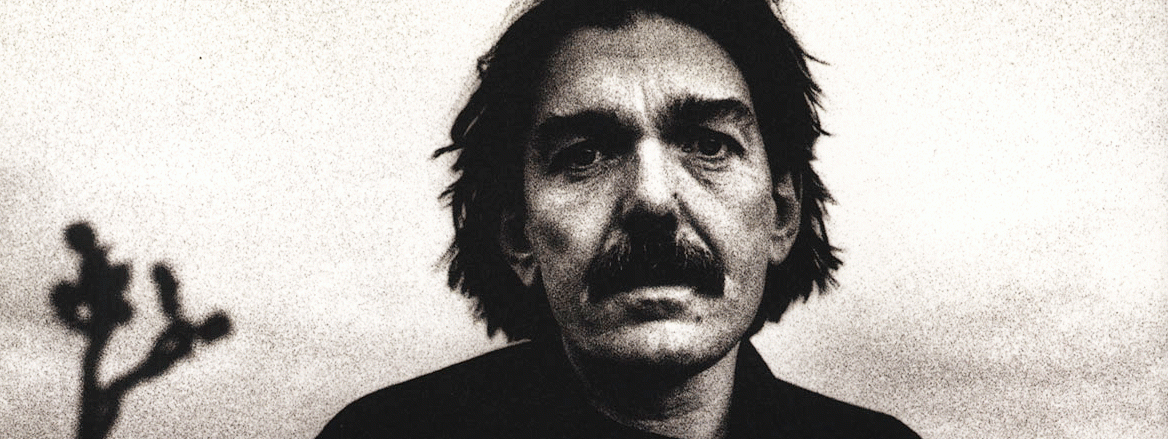
At the end of 2025 Moris Tepper released his seventh solo album, A Hand Carved Life, on his Candlebone label. This is his second album since his return to making and recording music following a brief hiatus of 14 years.
This new album is probably his most accomplished to date and showcasing how he has matured as a songwriter.
Moris has agreed to do a series of interviews with the Radar Station and we decided that the first of the series would be about this new album.
We get to talk about his songwriting method, some of his influences and coming to terms with the Beefheart style of playing amongst other things. So, make yourself comfortable it was quite a long chat!

To get the most from the interview I recommend taking a listen to the album, indeed, listen to the songs whilst reading the interview.
You can find the album on Bandcamp –
https://moristepper.bandcamp.com/album/a-hand-carved-life
or here –
and more about Moris on his website –
www.candlebone.com
 Steve Froy : Do you see this album as a sort of companion piece to Building A Nest [his previous album]?
Moris Tepper : I do. Precisely. I do.
SF : These two albums were released quite close together. But it had been a while since your last album – Stingray In The Heart was 2008, and A Singer Named Shotgun Throat was 2010. So there’s quite a gap.
MT : Right. There was a decade where I really involved myself with earning and not playing. I was definitely writing and recording tidbits. And some of those tidbits might be things that can be found on these last two records. But for the most part, I didn’t have the space. I really was intent on creating financial stability. Being responsible for someone else as well and wanting to make sure that we didn’t wind up homeless…. where I wouldn’t be able to record anything.
So, getting back in, I had a plethora of work and a plethora of ideas. Building A Nest, being 21 songs, one would think, okay, he’s said enough. But as soon as it was done, I was eager to get back to it. I feel this one is a more well-conceived production, for sure. I was able to get back in the chair of being able to (once the songs were written and recorded) mix and master at home, and kind of have all that. And I think, in terms of writing, I think there were a lot of ideas on the last record, Building A Nest. I think this one was more of like, now I can make this a little more concise as a geographic landscape.
SF : Sort of a distillation of the ideas.
MT : Yeah. Yeah. In all art, for me, it’s kind of more interesting undistilled, unedited. You know what I mean? I love sketches. I love drawings, also sketchbooks. I feel much closer to the artist in sketch form than in ‘finished’ work. I feel like I’m getting a personal glimpse into the artist, an intimate grasp of what their work is, far more than a polished, produced, finished product. It’s like their fingerprints are still on the work.
SF : That’s why I sometimes prefer listening to a live recording than to a studio album, because it’s rougher, it’s raw, and there’s more of the group’s personality there.
MT : Yeah, there’s more of the group’s personality there, for sure. But in terms of a singular artist, like a solo artist or a painter, you get more intimacy out of the sketch. The thing that’s more alive and less edited, of course.
SF : I can sort of understand why you called your last album Building a Nest now, but why did you call this one A Hand Carved Life?
MT : I liked the title. I fought with it a little bit, thinking, you know, building a nest, a hand-carved life, they kind of almost spoke to each other too much. I liked the poetry of that image, a hand-carved life. But I thought, wait a minute, my last record’s called Building a Nest, this hand-carved life, it’s like, they’re too close, it’s like this guy’s building things, you know? And they’re sort of, in image, they’re sort of the same thing. It’s life being built. A nest is where things are born. A hand-carved life, you’re creating a life, you know? I fought with it, and then I let go. I just like a hand-carved life, it just sounded good to me.
SF : As you said, you see them as a companion piece, so the way the titles link is cool.
MT : When it was done, I realized how much of a companion piece it was to Building a Nest.
SF : Right, so let’s get on to the actual songs. Golondrina is a great way to start, a really strong song. Golondrina – that’s the area in L.A. where the Trout Mask house was situated.
MT : Yeah, the actual Trout Mask house was on Ensenada Drive, though, so they’re sort of interlinked around there. Golondrina Street or Golondrina Place, I think, is the main thing that gets you to Ensenada Drive. When I was in junior high school, I had a couple of friends and they were frequenting the Trout Mask house. And I would hear stories about them going up to Don’s house and watching Jeff Cotton playing in front of a bush or eating a loaf of bread under a full moon.
SF : Yeah, I believe the band did have a house on Golondrina as well at some point.
MT : Yes, either prior or after. The name Golondrina always kind of stayed with me, almost sounds like an ancient priestess, or some kind of mythical female, beautiful but spiritual force. And also like a little girl, Golondrina, like a small vase.
And so what was happening was, I was listening to the Crazy Little Thing drum track and I was just jamming to it in a new way. And I started going, you know, I feel it’s okay to start playing in a format that is part of me that I’ve kind of avoided, like having a lot of the chordal fingerings that I was using in the Beefheart years. Then as the song was being written I went, God, I really like that as a title, Golondrina. As I continued writing the song it sort of started coming out like good things go. It was unconscious. I was writing,
‘Who’s that child goin’ for a ride on a candy colored train?
With a wild eyed smile always singing’ to the birds and walking’ in the rain’
All of a sudden, I realized I was talking about Don. It was like the first time and only time I’ve ever consciously/unconsciously written a song about Don. It’s a song, it’s not supposed to be an exact story. It’s just sort of an image of him and a feeling for him. I already had some of those guitar feelings and so I remember when I did the solo I was kind of going, you know what? I don’t play slide much anymore. I used to play slide a lot with Don. There’s a really energetic slide solo in this thing.

SF : The guitar playing on there was superb. Do you prefer metal or glass slide?
MT : Metal. And actually, this is the same slide that I used when I worked with him. I made maybe four or five of these because you’d lose them on tour and you’d lose one here and there. And I still have a few. They’re extremely heavy. I found a brass rod that was the right size for my finger and had it coated in chrome. I’ve tried lots of other slides but nothing ever felt as comfortable and as heavy and as sustaining as these slides that I made back then. So I was really happy when I found these, which may have led to me kind of going, yeah, let’s play some slide.

Don had a preference for extremely heavy strings. The strings being very thick, you know, I played that way for years so my fingers were completely used to that. They felt comfortable to me. And I noticed that over the years I’ve lightened my strings. I’m not a super slinky guy by any means, but I’m not using 12’s on the top E and 54’s on the low E, like I had when playing with Don. I’ve got 11’s on the top and 48’s on the bottom. It’s significantly lighter. When I was recording the guitar on Golondrina, I realized the difference of my string tension and the size of the strings from when I was playing in Don’s band.
SF : Next track is The Darning of the Seasons.
MT : Actually the original title was The Darning Of. I really liked that title and I didn’t know what it meant exactly. The Darning Of, I just like how it sounded. And, you know, darning is with needles and sewing, usually, sewing, you know, repairing socks, darning socks. And it was sort of like the repairing of the soul, the hurt. It has to do with love loss and then the eventual growth. And then the looking back at the torn heart, the mending of the years spent of learning to accept. That’s a very common symbol of life. Losing, you know, losing, accepting and through that loss and through that accepting, finding a power in your own heart to survive, and function through loss. That’s what life is. It’s getting and losing.
SF : It seems to have a positive end to it.
MT : Yes. And I think in my case and in most cases, it usually is a positive end. You usually find a way through loss to then appreciate life, even greater. You learn.
And there was a joy in working out the harmonies. On this record, there’s a few instances of multiple harmonies that are a little more involved than I’ve done on past records. I really enjoyed doing it.
This record is fairly singular, there’s a couple of drummers on the album. I’ve had bands to help record in the past but Building a Nest and this new one are a little more insular. I’m used to having some other voices and other instruments being played by musicians, more so than on these last two records.
On this tune there was an element of the blending of the melody and harmonies and just the feeling on that song that I was extremely happy with. There are certain songs that you record on an album, and when you look back they still kind of feel close to your heart and they make you joyous to hear. And that song very much does that for me.
SF : So have you become more comfortable in your singing then?
MT : I think I’ve long been comfortable in my singing. In my harmonizing though, I hadn’t done it to the extent that I did on this record. I think by using it more, I’ve gotten more comfortable with it. But I think the most easily, channeled insecurity is through the voice. When I first started singing, I was like, oh God, I have a horrible voice. I don’t like my voice. But once I started singing on a couple of recordings, a couple of songs, I gained confidence. I think it also helped that other people weren’t holding their ears when I sang. I think for a long time, I’ve been comfortable in my singing … of my material anyway.
SF : Next up is The Best Man’s Club. In my notes I’ve written very catchy, Beatles, question mark.
MT : Yeah. A little bit of a tip of the hat to the Beatles ’65 era, you know, that album, like No Reply. I think I had mentioned to a friend, I just want to write something that’s kind of like that early era, not super early, but like around Beatles ’65. That era where, you know, it’s a little nylon string and it’s just a simple song, but it feels like something close by your heart. That’s where it came from. I had the title, The Best Man’s Club written. When I hear things I like, I put them in my song titles list, which I have thousands of. Sometimes I go, Oh, I want to write a song, let’s look at the song title list.
I write all different ways. Sometimes I sit at a piano and the whole song comes through at once, which is rare, but it happens. Sometimes I’m playing guitar. There’s an idea and I start humming to it. Sometimes I have a bass and a drum track going for a feel. I start screaming. You know, there’s so many different ways one gets written, but often times when I don’t know where I’m going to go with it, I just start looking at the song title list.
In the case of the album, A Singer Named Shotgun Throat, titled by Don Van Vliet, I started with the titles. And I just started making up titles. I wrote down like 15 or 20 titles. And then I realized that they were kind of leaning towards this title that Don had given me previously for the album, Moth To Mouth. He said I should call it A Singer Named Shotgun Throat, but I liked Moth To Mouth more for that album. But I remembered that title, and as I saw these titles I’d written that morning, I started to see a theme between them when placed under the album title, A Singer Named Shotgun Throat, and when I came back from lunch I decided to just quickly, without thinking, make a verse and a chorus for each one of those titles. I didn’t write all the words but I sang and played some chords that gave me the setting, the template for the verse and some kind of template for a chorus for each of those titles and that was done in one afternoon. The album was recorded live in two days with three people. It was the only time I’ve ever made an album, like a thematic album, where the songs are about this one thing that’s in the title. It was a trip. It was fun. When I go back to that record, it’s one of my favorites.
There’s two sides to all this in terms of there’s the music, there’s musicianship, there’s instrumentation arrangement, and then there’s songwriting. Meaning songs to me are poems put to music or they are words put to music and they tell a story or they tell an image, okay a picture, but they tell it and and it really is about language and music coming together and I think my birth in music was The Beatles, Bob Dylan, the Rolling Stones, and then Beefheart.
I think I was 15 when I first heard Beefheart and it was very difficult for me initially to really enjoy it. I was enjoying it more because I had some friends that really enjoyed it that I respected and I was trying to like it. It took me a good year before I was like, yes, I really hear this. In fact, like the blues … that’s another thing that Don got me into, you know into a hot water closet … that got me started but until I lost my father, lost some girlfriends, walked home in the rain, lost certain things before I could really hear/feel the blues deeply in my soul, really enjoyed the comfort of the blanket of the blues. Same thing with Don, until I was in his band playing the music and even doing that for, it took at least a year or two before I really, you know, could eat that for supper, and be really happy. Before that it had been interesting and intellectual but not emotionally, deeply set in my bones and my blood, until I was actually in there playing it for a good deal of time.
SF : We’re gonna get off track if we follow that one I’ll come back to that later when we’re talking about the Beefheart albums.
Next up is the short instrumental interlude, Special Day.
MT : You can hear my fingers on the keys of the organ because the iPhone is sitting on the keyboard I’m playing, yep, an iPhone recording. I knew it was just a little nursery rhyme of a melody. When I heard it later I thought it just reminds me of like a nice new spring warm day and everything’s just like there’s no worries …
SF : Sweet Martha of the Banaroo. Who the hell is Martha? What’s a Banaroo?
MT : She has a clan. I’m sitting at a piano playing some bluesy heavy thing and just started singing ‘sweet Martha, sweet Martha of the Banaroo’. I had no idea what it was, which often happens, you start singing and you don’t know what you’re talking about. And then later you find out what you’re talking about and then you write the song based on what you feel that you were talking about. So I’m was jamming on a piano and I started singing those words and later I realized Banaroo sounds like a clan of crazy warriors somewhere. So it was written about the woman who leads them. She’s the leader as opposed to a male warrior leader. She’s the leader and she protects her people and, you know, the image of her riding at the front of the pack dressed in rope, fearlessly protecting her clan, and there’s a humor element in there too …
‘She chased out the Huns and the Romans too,
she drowned all the Christians and she swallowed the Jews’.
And I get to play some some fun slide on that that song as well.
SF : Yeah, there’s definitely some fine Magic Band sounding solo towards the end.
MT : That one has a drummer named Katsy Konecky, and he’s also the drummer on Best Man’s Club. When I got Katsy in there to do it… at first I was trying to get him to do just what I had done, just do it better … and he was like, there’s way too much, you got to open it up, and when he opened it up I was like, oh, yeah, he’s right because I have so much going on on the piano and so much going on rhythmically already.
SF : Well, next up is the serious song, A Real Fine Line. A heavy song!
MT : Yeah, I’d say in the last couple of years at this ripe age, I’ve really begun to see the end line. I mean, I’ve begun to truly realize that there is going to be an end. I actually wrote this song probably about two, three years ago. Just sat at a piano. I just started playing that piano part and the line, a real fine line, came to me then. But as I was recording it and bringing in the lyrics to it and relearning this piano piece, it just really became much more seriously true to the spirit and the soul of getting at the fortunateness of living this life here on earth and that the light goes out, you know, it’s going to go out and it’s supposed to. There’s something when you’re 20 and 30 and 40, you think yeah, I know everyone dies, I’m gonna die but it doesn’t, you know, it’s almost like you’re talking about an abstract idea or like you don’t really feel it. Part of it is what gravity is doing to your body and how much you start appreciating things you didn’t appreciate before. It’s like, wait a minute what’s wrong with me.
So A Real Fine Line feels very right now where I’m coming from in appreciation. There’s a loss of love, I’m talking about a past relationship in it. I’m talking about show me, you know, help me realize how I can be better, how I can stay here because I can’t so, you know … Anyway, there’s not a lot to say about it.
A very dear friend of mine who’s helped me through the years on different records in different ways. He’s the person who played bass and also mixed, A Singer Named Shotgun Throat. His name is Rob Laufer . He’s the drummer and the bass player on the Pretty Idiots on this record. He’s a wonderful orchestrator and he’s written a symphony that got played here in Los Angeles by a really great symphony orchestra. He’s a rock and roller and a gifted songwriter, close friend since early school days. He’s like one of those great musicians that can do anything, great guitar player and he did the orchestration both on this song and on The Visitor, from the last record, which is also kind of a heavy piano piece. So that kind of really added to that.
SF : It does help make it very atmospheric, the feel of it is something special.
MT : Yeah, I’m very grateful to have him work on that for me, and yeah, that’s about it for A Real Fine Line. I think the song says what it is.
SF : Yeah, and there’s a long pause at the end as well. Was that deliberate? The song finishes and there’s quite a pause before the next track, The Diving Tarantulas, comes crashing in. It’s a significant pause compared to the other ones on the album. It would have spoiled the the feeling if you’d come in too early, you just have time to recover from A Real Fine Line and then BAM tarantulas …
MT : First of all, I appreciate very much you actually listening to the record in the order of how it was meant to be heard. That’s very rare now. I can’t expect anyone’s gonna listen to it that way but I make the record (because I’m an old-school guy) like you start at the beginning and you listen through to the end and it’s a journey. So, when I timed the record, I definitely put in a longer pause there to feel the weight of that song.
I love The Diving Tarantulas and I love going from one emotion to a different emotion very much but I didn’t want to spoil your moments of pain at the end of A Real Fine Line with the humor of The Diving Tarantulas.
SF : I originally thought, why didn’t he put it at the end because then it would have been silence afterwards. But I think doing it the way you did it hits you even more because it’s in the middle of the record, it’s unusual to get that space,
MT : Also, I kind of didn’t want to lose A Real Fine Line at the end. I thought maybe someone would not get there. It’s one of the most special songs, in fact, for me the last song on the record is special to me, Unstoppable Force, we’ll get there.
SF : The Diving Tarantulas. Really dramatic beginning, crashing drums. I’ve written ‘circus performance?’ Is that what you were going for ?
MT : Yeah, The Diving Tarantulas. So it all started from an app on my phone. Got it, maybe five years ago for free called ‘BeBot’. It is one of the most amazing instruments. I tell every musician about this app if they don’t already know it. It’s laid out kind of as a keyboard. It’s actually lines that go across the screen, but it’s a synthesizer. It’s got presets and it’s got an organ sound. It’s got all kinds of Moog sounds and the way the keyboard works is as your fingers go up the screen, the filter opens. You can set attack, delay and all that but it’s so tactile, and so expressive.
I was sitting in at a doctor’s office waiting for my wife one day, sitting in the lobby, and I’m bored so I take out the ‘Bebot’ and make a little riff which repeats in all musical sections after the drums. And then I added an Arabic drum idea, and then a wonderful drummer/percussionist and good friend, Michael Tempo, played African drums, percussion and congas on it. Oh, yeah, when I started writing the lyrics of what it was, that’s when I added tympani … baboom … to give it a vibe that they’re performers, you know, “they were born to perform cabrioles” … all about these guys, these spiders that are doing somersaults and pliés and “Jumping off a hippopotamus, Just to find out where the bottom is ”
SF : Yeah, that’s a great rhyme, I love that
MT : That was fun to do. There’s some backwards electric guitar towards the end. I’ve just released the video for that song which I put together a bunch of spiders doing it, spiders flipping and doing cartwheels and mixed with some images from the album cover. I made some of those characters on the album cover do some funny things during the performance of The Diving Tarantulas.
SF : We’re up next to Milky Sea, which is another instrumental. Milky Sea. You mentioned ‘milky sea’ in Golondrina – ‘deep and Milky Sea’
MT : Yeah, again I had the title Milky Sea. I know it’s been used somewhere in other songs but I loved that image.
One night, coming home from a gig many years ago very, very inebriated, coming home like at two in the morning, I stopped at a gas station and walked in to pay and the attendant was sleeping and as I walked in I heard this music. It was like I walked into a dream, a Fellini dream with, you know stars coming down. I knocked on the window to wake up the attendant so he would take my money. I was saying, “Hey, hey, hey”, and he looks up I go “Who is this? Who is this?” I’m pointing to the speakers, “Who is this” and he says ‘gullamalley’ and like, I wasn’t sure I heard it right but what he had said was Ghulam Ali. I was like, I hope I’m getting this right cuz he wouldn’t even wake up, like, he took my money but he just seemed out of it and it wasn’t clear to me if I’d heard it right. The next day I went to an Indian record store, selling mostly cassettes, I think. I asked about something called ‘gullamalley’. The store owner says, “I guess you mean this” and he sold me a cassette of Ghulam Ali. The minute I put it in my car and, oh my God, it’s the exact same music! I still put on Ghulam Ali a lot, I love his Ghazals, which are basically prayers, you know poetry, and prayers being set to music. I don’t understand the language but the particular production of this music has got the right element of cheesiness and psychedelia against this very traditional spiritual melancholy, all together in this wonderful way that just pleases me absolutely and spiritually and at the same time reminds me of the days when I used to imbibe so heavily.
So, Milky Sea …
I played an electric sitar, made by Danelectro. They made one of them, you know, I think you may know this, in a lot of the early Motown music you would hear intros played on electric sitar. So I always wanted one of those instruments. I got one and I was like I gotta find a way to utilize this thing, I’ve gotta put it on something … and then, oh, Milky Sea, this is perfect
SF : Yes, it’s got a bit of an Indian feel there’s also a bit of a Chinese feel to it as well
MT : Yeah,
SF : And after that we come to Pretty Idiots, a bit of social commentary, pretty clear where you stand as regards to these people
MT : Yeah, it’s pretty obvious we don’t want to go down that road. I watch these late-night television shows here in America, they’re making fun of Trump’s Administration and Trump and the ridiculousness of it all but they do it all with humor and it makes me even angrier because it’s like this isn’t fucking funny. Why don’t these shows express the rage and frustration, instead of the ‘look how dumb he is’ humorous angle.
With Pretty Idiots it’s about the the idiocy of power, you know power always seems to be the rich and beautiful people and with the ugliest intentions and the ugliest souls, just vying for the most powerful place to control everything. How can they have this much greed and need without any care for the rest of us, without any awareness of that. We’re all here together. We want to make it last for the good of all, you know. So that’s all Pretty Idiots was about .. I got to get out of here. ‘I’m done living on the east side’. I just I can’t do this anymore. They’re ruining the earth.
SF : Let’s draw a line under it. You said that really well. We don’t need to go any deeper. So let’s move on to the shortest track on the album Imaginary Friend. Really heavy, it’s short and sharp, got very distorted voice on it
MT : I don’t know what to say other than that’s a side of me. There’s a past record, Stingray In The Heart, with a track called Ari Ari Mitsu, and it’s very similar in that it’s sort of the same feeling. There’s something about things that don’t overdo it and you just hear them for a glimpse but they’ve got like an energy about them that you wish you could hear more but if you did hear more you would realize that there’s not a lot to it beyond it’s energy. There’s something about it being that short, because I definitely had a conscious choice, shall I turn this into a three-minute rocker? Again, it’s almost like the sketches. It’s the idea, that blaring idea is stronger than anything I’m going to create out of that. And with that particular one, it was like, no! I love how that is. It’s like when you’re doing a taste test you have a glass of water to rinse your mouth to clear your palate. It’s a palate cleanser,
SF : Yeah, it does that. And then strangely the next track, If The Sea Was Blue Enough, the first line is ‘gone in a blink and where did you go’. Was that intentional? It’s a wonderful link! This is another acoustic song and there’s again a sense of loss
MT : Yeah, I think I had that chorus for five or ten years and it kept going, “you should do me, you should do me”. It seemed appropriate enough so I did it.
I think talking about the meaning of songs like this, it’s a little ridiculous because they’re all obvious what they mean. Mostly you want the listener to project their own meaning over the song. What you just said, it’s about loss and it’s just another beautiful painting with sadness and memory. I think of the bridge,
“I can still remember flying paper planes,
As we watched our shadows fade against the window pane”.
Mike Hamilton sings the the harmony on that song. He and another friend from our high school at the time, would go and visit the Captain and watch the band rehearse. He’s got lots of great stories about hanging out at the Trout Mask house as a kid. He was the reason I brought home Trout Mask Replica and Safe As Milk, to my father and my brother’s very large discontent.
I sat on a school bus the day that Jimi Hendrix’s Are You Experienced record came out. Hamilton had the record in his hand. Two days later me and two other friends, Rob Laufer, the other being Eric Feldman were sitting in Hamilton’s bedroom and he plugged in his guitar and played every song on the record!! All of Jimi’s parts…It was just such a blow mind. I remember visiting him shortly after the Beatles White Album was released and he was playing Martha My Dear on the piano. I’ve learned it recently, it’s difficult. This kid was 15 years old, one of the those… He also wrote songs at that time that still to this day are amongst my favorites ever. I got those high school buddies, Mike Hamilton, Eric Feldman, Rob Laufer and Rick Redus (who played on Shiny Beast and toured with Beefheart as well), I got all of them together and made a song called Power to the Homies on the last record, which was a memorial to our youth and that we are all still here.
So on this record, getting back to If the Sea Was Blue Enough, that’s Mike Hamilton singing backgrounds on that.
I think the next one is When Nature Calls.
SF : Yeah, That’s right. When Nature Calls. A lot of wah-wah on this one.
MT : Yeah, there you go.
So that is the first song I recorded for the record. As I was finishing or mixing, Building a Nest, I probably started writing that song. What happened is I got a wah-wah pedal. I never ever played pedals. That’s not my thing. I just suddenly was like, I want to play some guitar through a wah-wah pedal. So that was that. I kind of thought about Cream. I thought about Tales of Brave Ulysses and the way that works in that. That was sort of the impetus for that tune. Wah-wah.
SF : It’s also got a bit of an off-kilter beat where something’s going on with the beat. I hear it but I don’t quite understand what, quite what’s going on.
MT : Whatever that is, it was intentional. But, it never struck me … I think where the drums come into the guitar, it feels like it’s almost backwards.
SF : Yeah, I’m not really musical, so I don’t really understand how these things work. I recognize it as something wasn’t quite, not right, but it was just different, I just wondered what was going on there.
MT : Happy to cause confusion.
SF : Yeah, I’m easily confused. I’ve also made a note here, and that the chorus – ‘It’s only Monday morning…’ – seems very David Bowie-like to me, from sort of Man Who Sold the World, Hunky Dory, that sort of era.
MT : Wow, wow, wow, wow. I love Bowie. I’m not even that familiar with that era so much. I’m more of a Low, Heroes era guy… Young Americans is really where I start going, oh, I love Bowie. Young Americans and on up until Scary Monsters. I’ve heard Hunky Dory, but never got into it, never heard it more than once, you know, other than what might have been on the radio, but his sound is something I love. He had a song towards the end called Where Are We Now? So deeply moving. Do you know this song? He was such a monster visually as an artist and musically. I remember Ashes To Ashes. People were making these really lame videos for MTV. He was making cinematic masterpieces.
SF : Another note I made about When Nature Calls. Is it an ecological theme that you’re expounding?
‘You can hear the hunters coming.
There’s no time to hesitate.
Just keep running when nature calls.’
Yeah, when nature calls, I’m a nature lover. Something Don and I shared very deeply was our love of nature and our love of animals. And there is something about it … there’s also a funniness, you know, there’s something going on about it …
‘It keeps talking to you every time you turn around.
It’s lying in the grasses.
The pattern of your footprints laying on the ground
leaves such a sad impression.’
It’s about humans trampling over the earth and not listening to or seeing what’s there. There’s no time to wait. You need to get out of the prison you’re living in and get back to nature, it’s calling you back. You can read in there that it’s meant to be about man and nature.
SF : Which brings us to another folky acoustic type song, Unstoppable Force, which I’m guessing is you’re talking about the life force.
MT : Yeah. Yeah. I’ve had an image in my mind’s eye throughout my life. It’s something about a lynx. You know, it could be a snow leopard, but there’s something about the lynx and the snow and the power and the earth. I’m not going to be able to verbalize here as clearly as the song does, but it is about the life force, the force of life. And at the top of the mountain, at the top of the earth where that icy perspective overall lives, there’s a lynx and he’s the king and he has a golden cape and he doesn’t see the daylight and outside the flowers are putting out that perfume that creates, right at the exact moment that it allows the pollen to get to the next thing and bear life again.
The more I would talk about it, the more I would destroy what the beauty of that song is. But you hit on it exactly that it’s about a perspective of overall, the whole thing, there’s my concept of God which I think many of us share, which is it’s just everything and the life force that connects us, conscious or unconscious. It’s All, I’m good with that.
SF : I’m with you on that one.
MT : It’s not good or bad. It just is more this animal at the top of the world which is sort of seeing all. He’s not controlling it, but he symbolizes the unstoppable force of life, he’s a witness to all of it. He’s sort of the king of all. And what does he do? He’s grabbing things with his claws and chewing their necks off. You know, it’s like the most terrible thing from one perspective is the most beautiful thing from another.
That’s what life is. Life is tearing the neck off of something else. And it’s a flower opening and pollinating in the wind. And it’s all nature, these natural things that I love and that I’m really so appreciative of, much more than a computer or a phone or a car, just the the beauty of the nature of what we have here and how man seems to have really done everything he can to run away from the most beautiful thing here.
It’s got a very complicated chord structure, actually. As a listener, it may not sound that complicated, but if a player tries to play that song, it never repeats. It’s all over the place, changing all the time. And I remember when I first started playing the chords, before lyrics, on an acoustic guitar, just kind of playing this composition and then trying to be open.
There’s a songwriter named Jack Bruce, and I don’t mean this in terms of Cream, I mean, post Cream. He made two amazing solo albums, Songs For A Tailor and Harmony Row. There was a writing style on those records and it wasn’t jazz and it wasn’t rock. It was kind of folk. Open, new, kind of like Beefheart in being unique, in terms of a place to write from. I think I had that intent when I was playing that acoustic guitar part to kind of allow myself to not repeat and just stay within the tone of it. Not follow some kind of eight bars or any of that, and when I decided to double the acoustic guitar, I realized how complex it was.
SF : Which brings us to the last song, Leaving It All Behind, very appropriate, which is just a short instrumental and it’s got the piano and sort of brass band feel.
MT : Yeah, yeah, leaving. I almost see these poor schlumps leaving town, kind of raggedy taggedy. Like they’ve lost everything, but they’re still playing their their hearts out, warmly sentimental. It felt like an exit.
SF : It’s a nice cosy ending in a way.
MT : Yeah.
It’s sort of useless to try and explain songs that have so much power to them and it could be someone else’s song. Like Unstoppable Force or A Real Fine Line, it’s so hard to talk about them because they’re so deep and they’re so personal and at the same time they’re not personal at all. Everybody has this in their soul and heart. It’s the reason they’re powerful and big. They’re not just like, oh, it’s this idea about just this, it’s sort of a mirror and a reflection of everything we are. I love art that beams out the artist’s truths about life and relationships and allows the listener to reflect on their own truths as well…there’s just no way to talk about it other than to emote it in song or paint to some kind of fractured degree.
I really appreciate this opportunity, Steve. It’s just a hoot for me to have someone who’s listened to it and interested to hear some of the back stories of it’s creation.
SF : Thanks for taking the time out to talk to us, Moris, it’s much appreciated.
Text copyright 2026 Steve Froy & Moris Tepper
Photographs copyright Moris Tepper. Used with permission.